Na va-nad

Joseph’s musings 🎗️

  • Post updated July 12, 2026: The figures now cover the complete June 2026 heat wave, including observations through July 3.

    Data source and script

    The data come from the Météo-France daily or hourly climatological observations published on data.gouv.fr.

    The script used for the calculation is available as a GitHub Gist: joseph-sch/5b6399552efa0c431b6a2bfe94a88218.

    Final summary for June 18-July 3, 2026

    Paris stations

    MetricParis-LuxembourgParis-Montsouris
    Days above 35°C1010
    Longest run above 35°C10 days10 days
    Run start2026-06-182026-06-18
    Run end2026-06-272026-06-27
    Daytime excess above 35°C36.9 °C·days24.6 °C·days
    Night excess above 20°C41.9 °C·nights34.2 °C·nights
    Highest Tmax42.1°C40.5°C
    Highest Tmin28.4°C26.6°C

    What the numbers show

    The Météo-France hourly observations show ten consecutive days with maximum temperatures above 35°C at both Paris-Luxembourg and Paris-Montsouris, from June 18 to June 27, 2026. Paris-Luxembourg reached 42.1°C and accumulated 36.9 °C·days above 35°C, compared with 40.5°C and 24.6 °C·days at Paris-Montsouris. The nighttime burden was also greater at Luxembourg: 41.9 °C·nights above 20°C, versus 34.2 at Montsouris.

    August 2003 comparison period

    For comparison, the same script was run on Météo-France daily observations for July 25 to August 20, 2003.

    Paris-Montsouris

    MetricAugust 2003June 2026
    Days above 35°C910
    Longest run above 35°C9 days10 days
    Run start2003-08-042026-06-18
    Run end2003-08-122026-06-27
    Daytime excess above 35°C28.1 °C·days24.6 °C·days
    Night excess above 20°C35.0 °C·nights34.2 °C·nights
    Highest Tmax39.5°C40.5°C
    Highest Tmin25.5°C26.6°C

    Paris-Luxembourg

    MetricAugust 2003June 2026
    Days above 35°C1010
    Longest run above 35°C10 days10 days
    Run start2003-08-032026-06-18
    Run end2003-08-122026-06-27
    Daytime excess above 35°C36.0 °C·days36.9 °C·days
    Night excess above 20°C19.0 °C·nights41.9 °C·nights
    Highest Tmax40.2°C42.1°C
    Highest Tmin23.2°C28.4°C

    Comparing June 2026 with August 2003

    At Paris-Montsouris, the June 2026 episode lasted ten consecutive days above 35°C, one day longer than the nine-day sequence from August 4 to August 12, 2003. Its peak was also higher, 40.5°C versus 39.5°C, but its cumulative daytime excess remained lower: 24.6 °C·days in 2026 versus 28.1 in the 2003 comparison window. The nighttime excess was similar but slightly lower in 2026, at 34.2 versus 35.0 °C·nights.

    At Paris-Luxembourg, the 2026 heat wave matched the ten-day 2003 sequence. Its peak temperature was higher, 42.1°C versus 40.2°C, and both cumulative excess measures were also higher: 36.9 versus 36.0 °C·days during the day, and 41.9 versus 19.0 °C·nights at night.

    Conclusion

    The completed observations place the June 2026 heat wave in the same range as August 2003 by duration, with ten consecutive days above 35°C at both ground-level Paris stations. In central Paris, represented by Paris-Luxembourg, 2026 exceeded the 2003 comparison in peak temperature and nighttime heat burden. At Paris-Montsouris, however, August 2003 still produced the greater cumulative daytime excess despite its slightly shorter run. The comparison therefore does not yield a single citywide "winner": June 2026 was exceptionally long and intense in the urban core, while the severity of 2003 remained more pronounced at Montsouris by cumulative daytime excess.
  • I’ve done some crawling and data visualization, with the help of Codex.

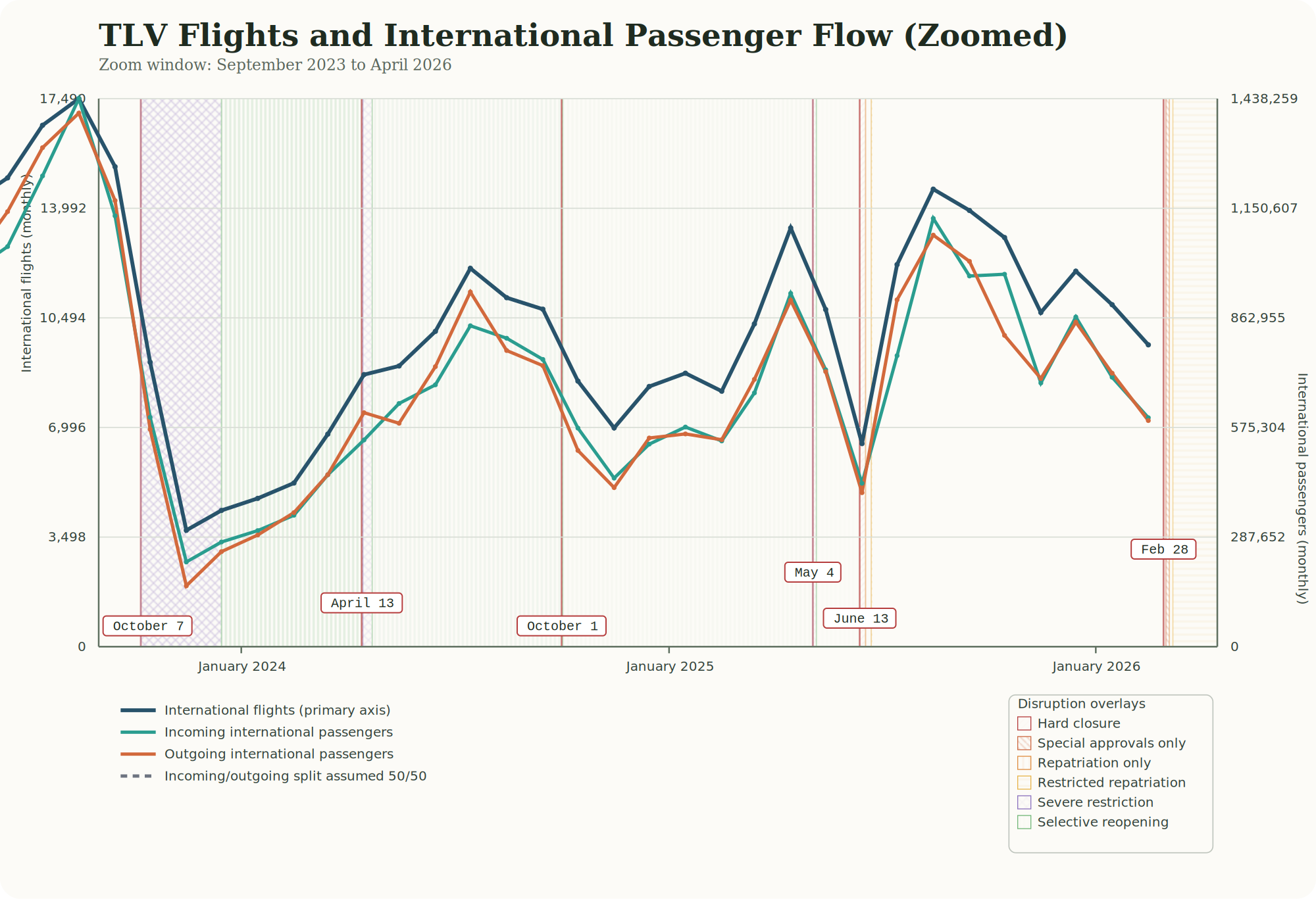
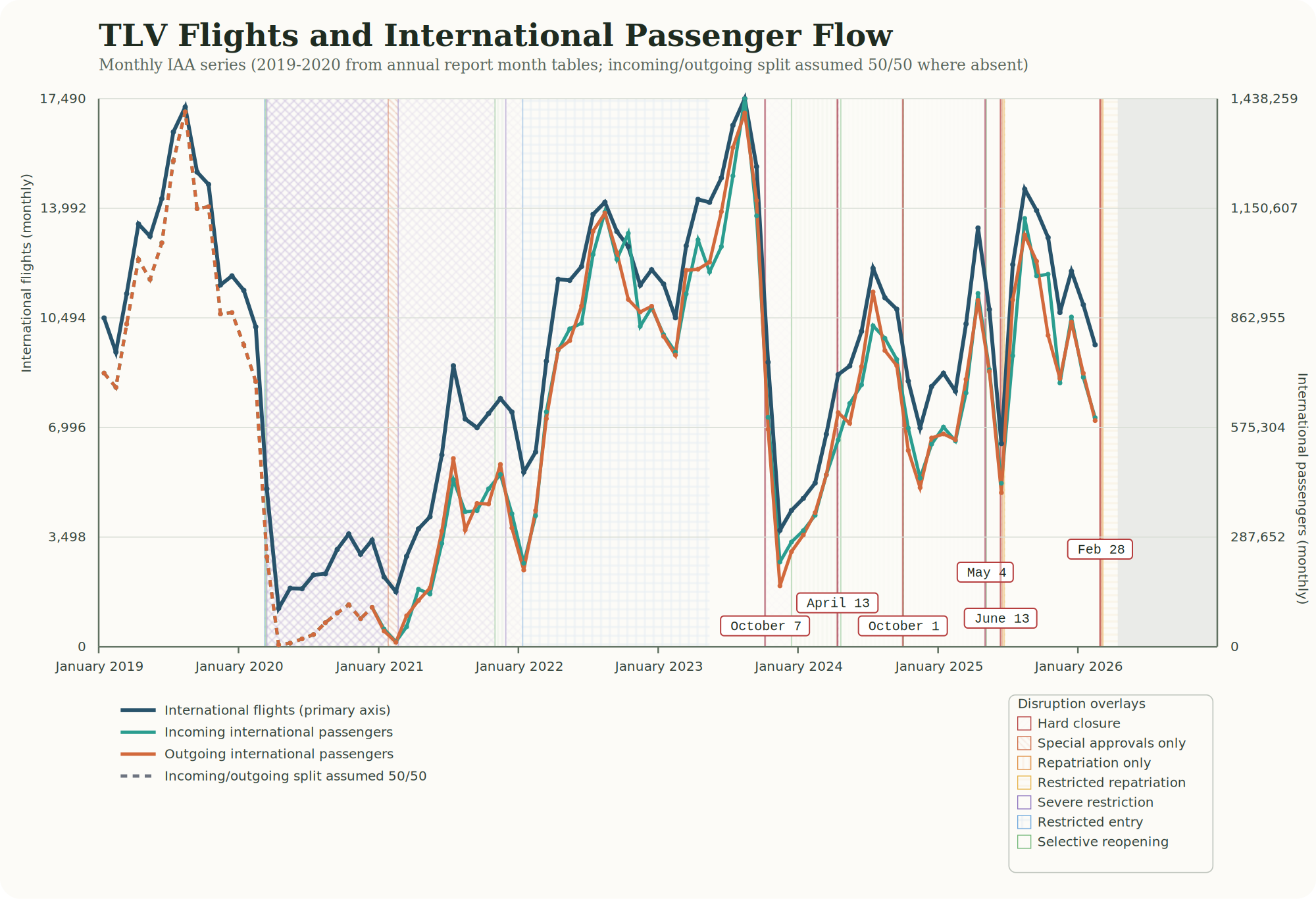
    Chart 1: Monthly International Flights and Passengers

    The following chart shows:

    • Total count of international flights per month (incoming + outgoing) – on the primary axis
    • Counts of incoming and outgoing international passengers – on the secondary axis
    • Disruption overlays for closure/restriction periods
    Chart 1 - TLV flights and passengers

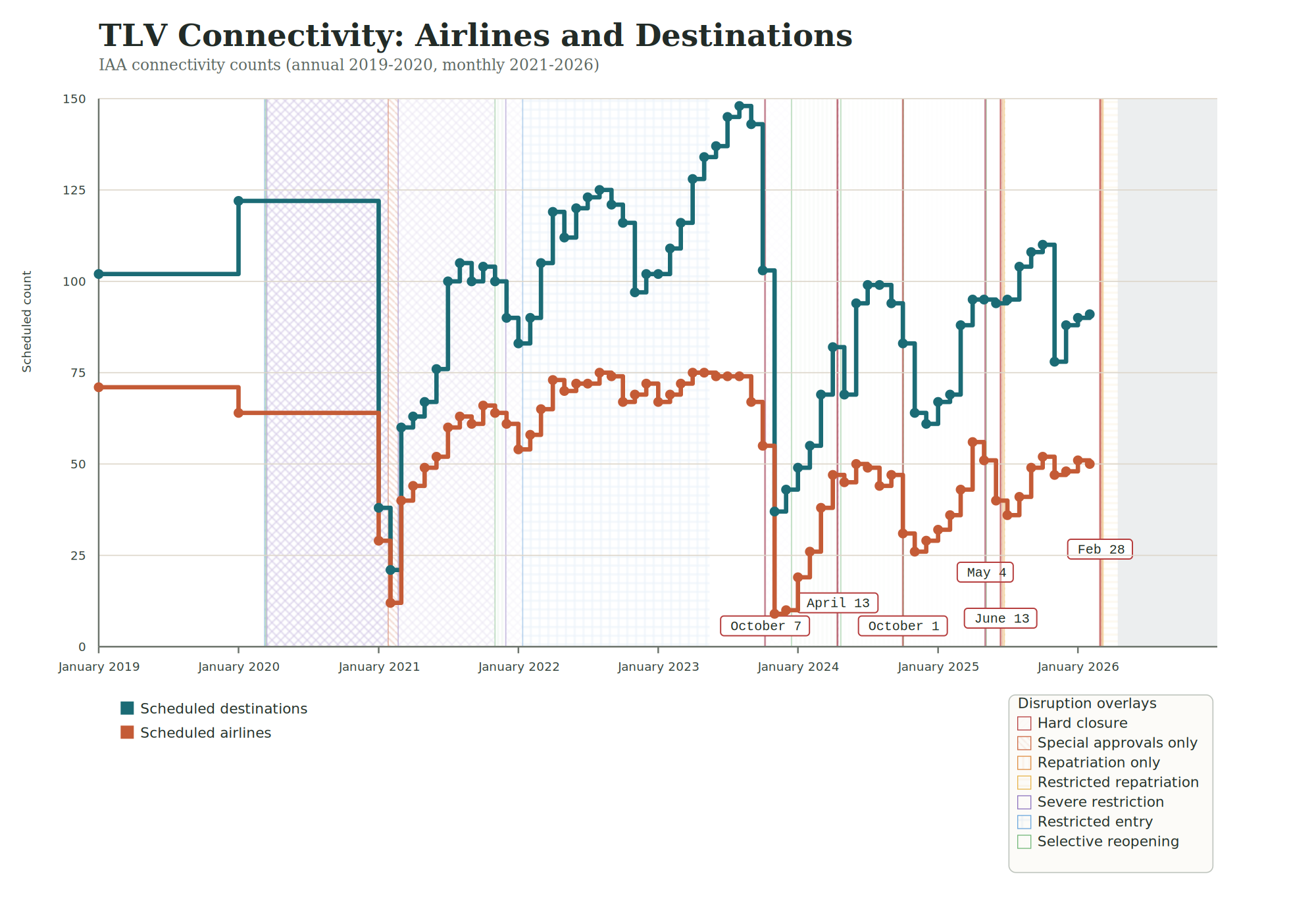
    Chart 2: Scheduled Airlines and Destinations

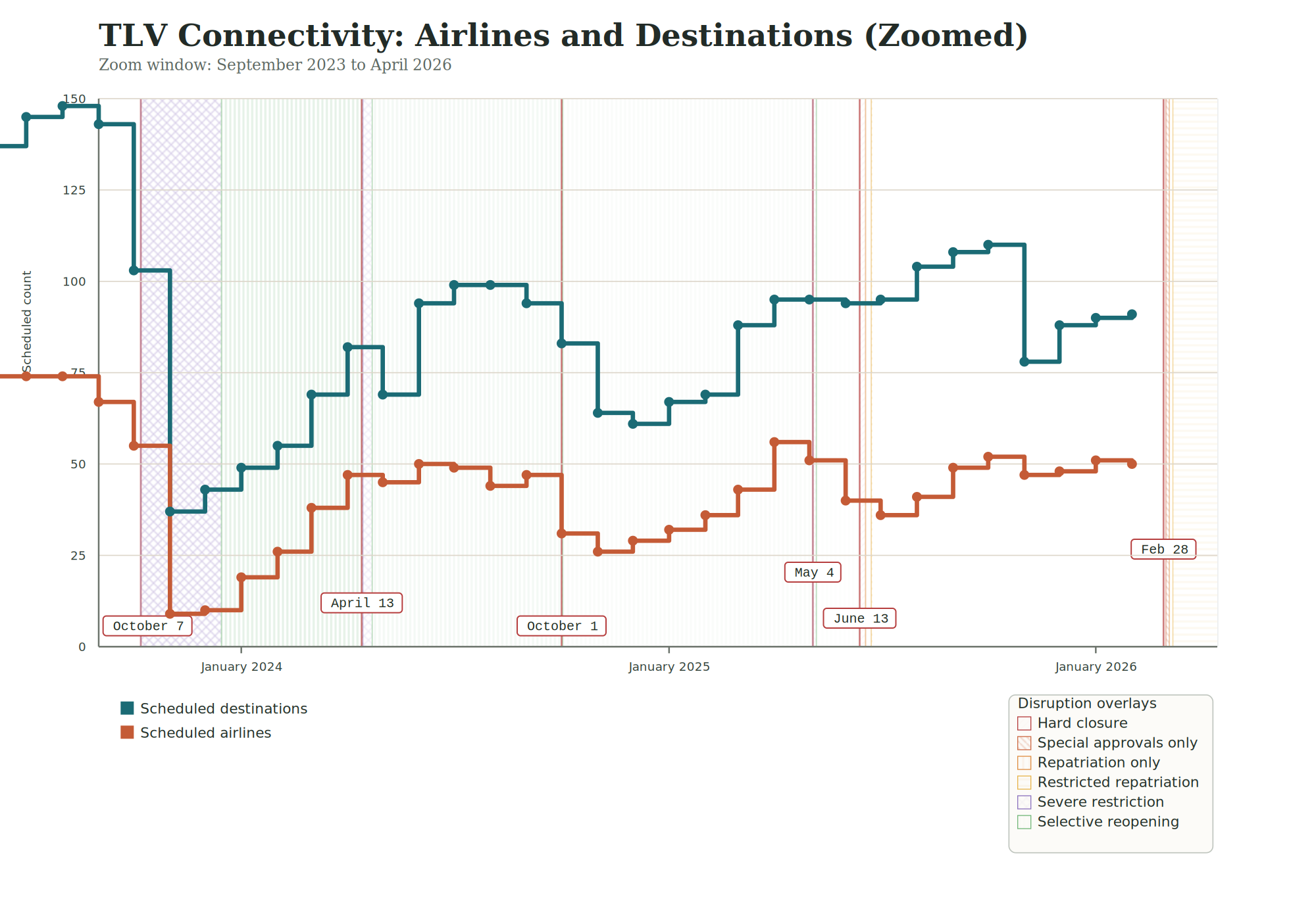
    How many airlines operated to and from TLV / LLBG (Ben Gurion Airport)? How many destinations are served by scheduled flights?

    The following chart shows:

    • Airlines which had scheduled flights (annual counts in 2019 and 2020, then monthly)
    • Scheduled destinations (annual counts for 2019 and 2020, then monthly)
    • Airspace restrictions and travel restrictions overlaid

    Caveat: The IAA reports include “OTHERS” rows in both airlines and destinations tables, so the actual number of airlines and destinations may be higher than shown in the chart.

    Chart 2 - TLV connectivity

    Zoomed View (September 2023 to April 2026)

    Chart 1 (Zoomed) - TLV flights and passengers
    Chart 2 (Zoomed) - TLV connectivity

    Sources

    Data

  • According to Wikipedia:

    The term “vibe coding” was coined by Andrej Karpathy in February 2025; Merriam-Webster listed it as “slang & trending” in March 2025; and Collins picked it as Word of the Year for 2025 (link, link, link).

    Back then, in early 2025, it was a more-or-less derisive term, depending on who used it. It came with a strong assumption of serious limitations, criticisms about security flaws, and the idea that “it’s for beginners / non-coders”, not for experienced developers.

    But now, two and a half months into 2026, the data shows the term’s usage is still growing. The tools that rode a wave of hype related to vibe coding in 2025 did not all survive the hype cycle. But the broader behavior of using coding agents is becoming more entrenched, and the term “vibe coding” is still in active use in early 2026.

    Quick caveat: This post is based on Google Trends but Google Trends gives relative values (0-100), not absolute search volume. So we see “how interest moved” within each trend, we cannot compare directly trends between one another. Even search volume in turn, is only a proxy for interest, not a direct usage meter.

    Two peaks in 2025, then a higher 2026 level

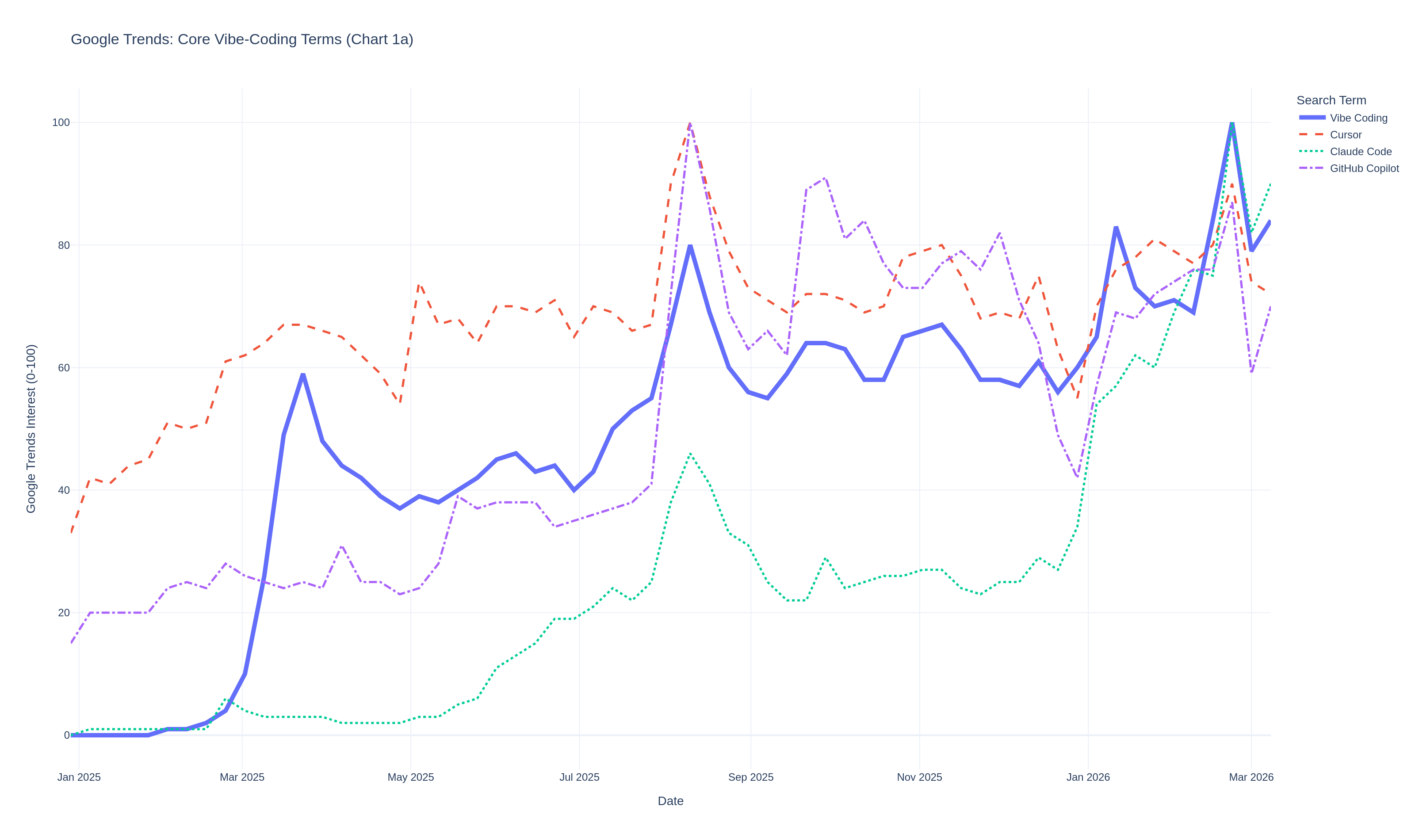
    From Chart 1a/1b, the “vibe coding” query shows two clear peaks in 2025:

    1. Spring 2025 (first real breakout, around late March / early April)
    2. August 2025 (a second, larger wave, from a summer baseline around the 40s to a weekly peak near 80, then a slight cooldown)

    In the last two and a half months (January to mid-March 2026), there looks to be a continued expansion: we see 83 in mid-January and 100 in late February, and March remains elevated.

    A cleaner way to summarize the magnitude: from the March 23, 2025 local high (59) to the February-March 2026 average (about 82), the level is up by roughly 40%.

    Chart 1a: Core terms (Vibe Coding, Cursor, Claude Code, GitHub Copilot)

    Chart 1a: Core vibe-coding terms

    Claude Code’s rise is the most obvious late-period acceleration in this set (link). GitHub Copilot looks more mature and flatter by comparison, while attention shifts toward newer “agentic coding” labels and tools. One plausible context point is OpenAI’s Codex relaunch/push, which may have redistributed mindshare across names and workflows (link).

    Also, this chart is intentionally selective. It does not include Google’s coding tools, for example.

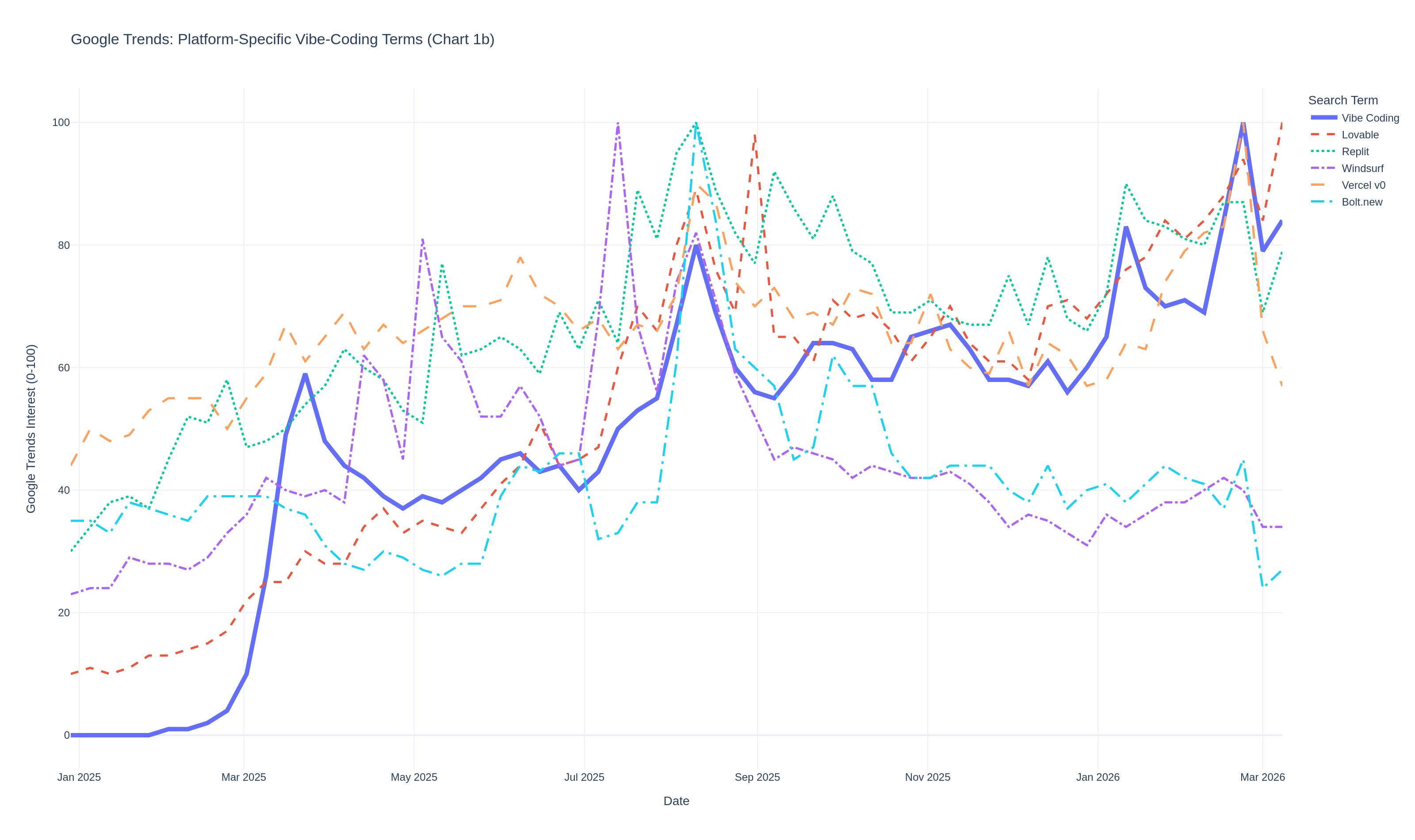
    Chart 1b: Platform wave (Vibe Coding + Lovable/Replit/Windsurf/Vercel v0/Bolt.new)

    Chart 1b: Platform-specific vibe-coding terms

    The “platform wave” look is pretty clear: a broad lift into August 2025, then separation.

    • Lovable, Replit, and Vercel v0 hold up better afterward (with Lovable and v0 still very visible in later points) (link, link, link).
    • Windsurf and Bolt.new fade relative to their peaks in this specific search slice (link, link).

    Why might that happen? Usually it’s a mix: category crowding, feature convergence, and users consolidating around fewer default tools as “AI coding” becomes normal rather than novel.

    Chart 2: “How do I get started?” query intent

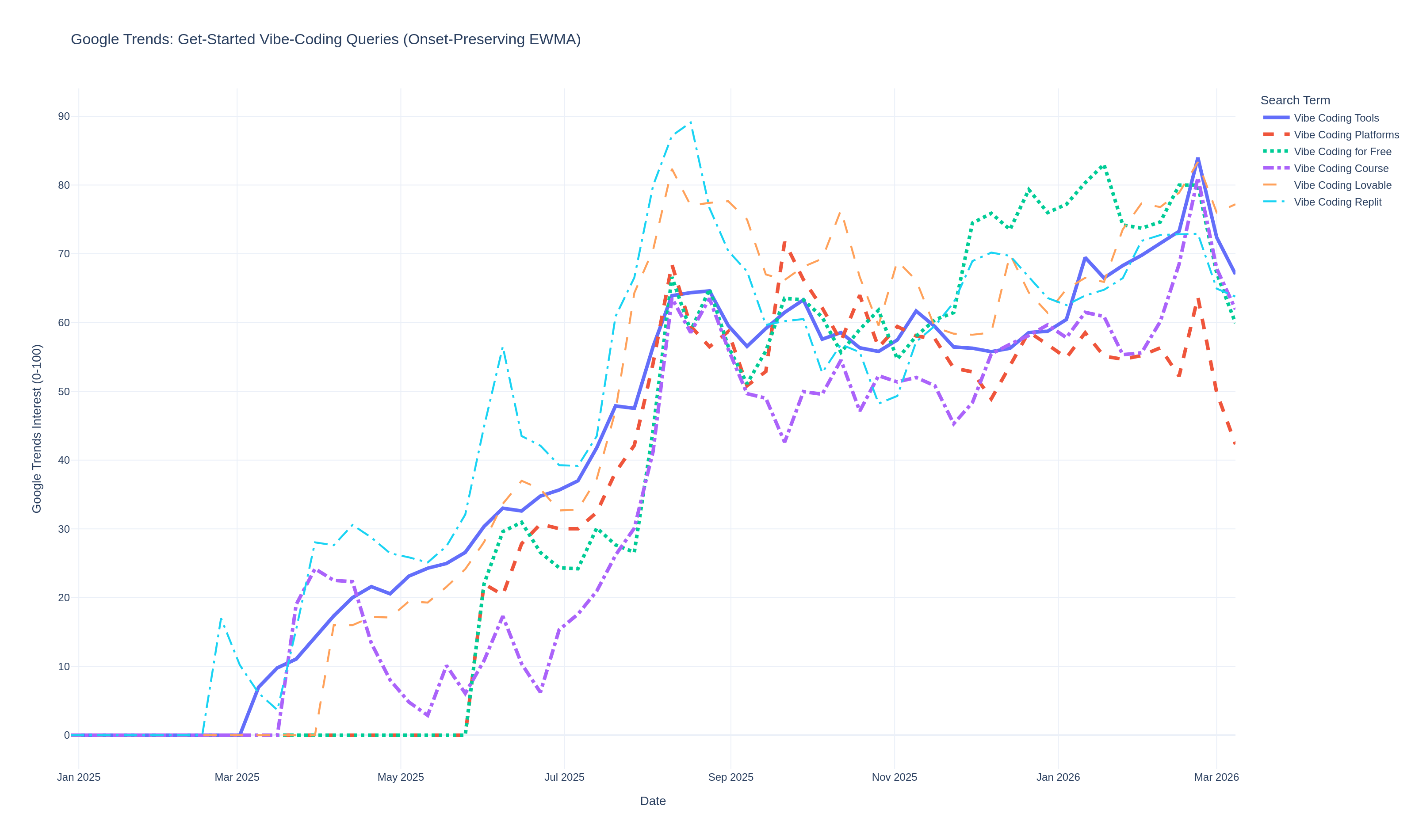
    Chart 2: Smoothed get-started vibe-coding queries

    For this chart I filtered out terms that repeatedly dropped to zero in the second half of 2025 and used onset-preserving smoothing, so we keep direction without overreacting to one weekly bucket.

    The key read is that generic “vibe coding” how-to intent does not explode upward on its own. Instead, intent fragments into tool-specific behavior: Claude workflows, Cursor workflows, Replit workflows, and so on.

    Conclusions

    My initial expectation was wrong. The term has not disappeared after 2025. It is still in active use in early 2026, and the broader behavior is of course even more entrenched.

    “Vibe coding” still means “obtaining code (for a web site, a web app, any piece of software) through prompts”, but the assumptions of hard limitations, security flaws, and “only for beginners or non-coders” are totally passĂ©, in a world where coding agents are becoming standard developer tools.

    Data and method notes

    • Data source: Google Trends weekly series, Jan 1, 2025 to Mar 8, 2026 (link).
    • Important: this is relative index data, not absolute volumes.
    • Charts are from local CSV pulls and custom Plotly PNG exports.
  • Before it was called World War One, WWI was called in French “la der des ders”, in English “The War To End All Wars”.

    Here in Israel, there is still a prevalent thought that another road, another lane, another interchange or another tunnel will “put an end to all congestion (forever)”. Road 6 was supposed to be the ultimate solution for the whole country: “The Road to End All Congestion”. Instead, apart from being an eyesore and a terrible environmental scar, it is itself congested every day: it turns out, to no serious person’s surprise, that by leading people to believe they can reside wherever they want and rely on a fast commute on Road 6 to wherever they need to be for work, to visit family or for entertainment, you create the conditions for no one to be able to do that.

    Well, I’m starting to see a parallel here with Israel’s wars. Each one was supposed to be the end to Hamas aggression from Gaza, to Hezbollah’s rockets and threat at the northern border, to terror in the West Bank, to Iran’s ballistic missile threat… and then we need another one to achieve the same goal again – doesn’t that sound familiar?

    I wish the prospects for the future of regional geopolitics were more like building high-speed train lines, mass transit and livable cities and less like building Road 6.

    To be honest, in terms of transportation, the transition is not complete but I can see high levels of the technocratic state have understood the need for proper mass transit and livable cities. So now we need to send Netanyahu home and have a new government which tasks itself with bringing us a sustainable future.

    Congestion on Road 6, Israel Picture by Shlomi Yossef צילום: שלומי יוסף Reproduced from https://www.globes.co.il/news/article.aspx?did=1001449683
    צילום: שלומי יוסף

  • Elon Musk has been so wrong about so many things for so long… But I want to focus on the Second Generation Tesla Roadster.

    Tesla asked for serious money for the second-generation Roadster: about $50,000 for a regular reservation, and $250,000 upfront for the Founders Series. Just the Founders batch was capped at 1,000 people, so that alone is a lot of customer cash tied up, and Tesla has never really published a clear total for all reservations. By late 2025, several well-known cases said getting a refund was more painful than expected, with no easy one-click cancel, lots of follow-ups, and unclear timelines for when money would actually show up. So after years of waiting, some buyers ended up stuck not just with delays, but with a refund process that felt messy and unpredictable.

    DateQuoteSourceWhat It Means
    2017-11-16“hardcore smackdown to gasoline cars”CNBC (Roadster unveil): linkHe was basically saying this wasn’t just another EV, it was meant to embarrass gas supercars.
    2017-11-16“This is the base model”TechCrunch: linkTranslation: even the wild specs from launch were supposed to be the starting point, not the ceiling.
    2018-06-09“SpaceX option package for new Tesla Roadster will include ~10 small rocket thrusters”Electrek: linkThis is where Roadster talk jumped from fast-car hype to rocket-assisted performance hype.
    2018-06-09“Maybe they will even allow a Tesla to fly …”Electrek: linkHe leaned into sci-fi mode here and kept the buzz alive by not drawing a clear line.
    2021-09-01“new Roadster should ship in 2023”CNBC: linkAnother reset: a fresh target date to reassure people the project was still happening.
    2023-05-16“this is not a commitment” / “hopefully start production next year”TechCrunch: linkHe gave people a timeline, then immediately softened it so it wouldn’t count as a hard promise.
    2024-02-28“Production design complete and unveil end of year, aiming to ship next year.”Reuters via Yahoo: linkThis sounded like the most concrete update in years: design done, unveil soon, deliveries next.
    2024-02-28“There will never be another car like this”CNBC: linkHe framed it as a one-off halo car, basically saying this thing is supposed to be in a class of its own.
    2025-07-13“Most epic demo ever by the end of the year. Ever.”Electrek: linkBig promise, big hype, and another year-end milestone that people would watch closely.
    2025-10-31 (interview), reported 2025-11-01“I can’t do the unveil before the unveil.”Yahoo Tech: linkHe kept details vague and didn’t kill the flying-car speculation, which kept the suspense going.
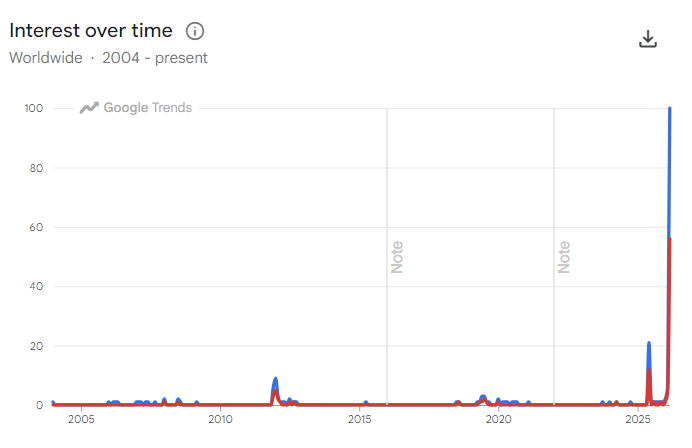
  • I was thinking overnight – I wouldn’t be surprised if the searches on Google for “Strait of Hormuz” peaked every now and then when the situation in the area gets tense. Most of the time, no one really knows or cares about what the Strait of Hormuz is. But I wasn’t ready for such a Google trend:

    A blue and a red trend for hormuz and strait of hormuz respectively of worldwide Google searches since 2004, with a peak at 9 and 5 in January 2012, 21 and 12 in June 2025, 100 and 56 in March 2026.

    What happened in January 2012?

    In January 2012, tensions spiked after Iran threatened to close the Strait of Hormuz in response to new U.S./EU oil sanctions and the U.S. Navy signaled it would keep the waterway open.

    What happened in July 2019?

    In July 2019, tensions surged again during the tanker crisis, especially after Iran seized the British-flagged Stena Impero following earlier tanker seizures and U.S.-Iran military incidents.

    Obviously, June 2025 and … now, March 2026…

    Suddenly everyone needs to know what the Strait of Hormuz is!

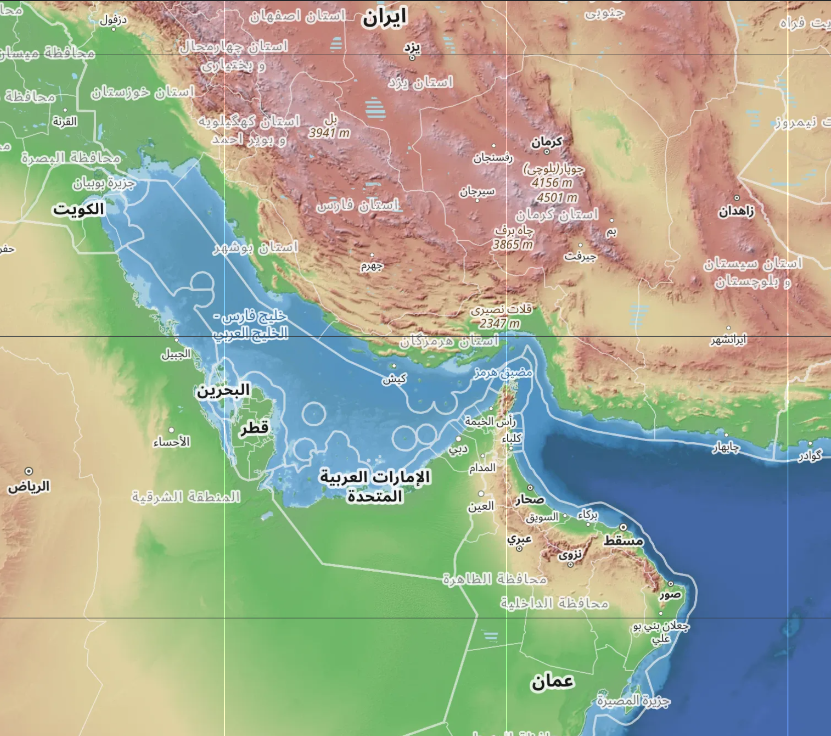
    topographic and polical map of the area surrounding the Strait of Hormuz, labeled in Arabic characters

    Even on a map in Arabic characters, you can find it…

  • Another war…

    Sirens…

    Giving blood…

    The situation won’t ever be the same…

    Until the next time…

    Joseph giving blood at Magen David Adom
  • I might have applied quite heavily the filter (increased saturation, etc.) but only in order to be truthful to the sensation. Photo taken November 14, 2025 at 8:23 AM, local time.

  • In the previous rambling, Randomness in LLMs, preamble 1, I tried to illustrate how the LLMs I’m familiar with inherently use randomness to generate their answers and as such do effortlessly something that we humans are not very good at – at least I’m terrible at playing the categories game, or at coming up with a “random” recipe choice.

    I would like to illustrate now, how this can come into play in something serious. I’m quite fascinated by the Shapira Fragments, a.k.a. The Valediction of Moses, and I did the following experiment:

    I said:

    Make the point for or against the authenticity – but only one of them – of the shapira fragments in three sentences

    ChatGPT said:

    The Shapira fragments are likely authentic, as their linguistic patterns and orthography resemble pre-exilic Hebrew rather than the later Biblical form known in the 19th century.
    Such features would have been almost impossible for a forger of that era to reproduce accurately, given the state of Semitic philology at the time.
    Moreover, their thematic differences from canonical Deuteronomy suggest an independent source tradition rather than a derivative imitation.

    I said:

    Make the point for or against the authenticity – but only one of them – of the shapira fragments in three sentences

    ChatGPT said:

    The Shapira fragments are almost certainly forgeries, as their sudden appearance without archaeological context and their convenient alignment with Shapira’s commercial interests raise clear suspicions.
    The leather strips reportedly disintegrated conveniently soon after examination, preventing any modern testing.
    Moreover, the linguistic oddities once taken as archaic are more plausibly explained as mistakes by a 19th-century imitator unfamiliar with genuine early Hebrew usage.

    I said:

    Make the point for or against the authenticity – but only one of them – of the shapira fragments in three sentences

    ChatGPT said:

    The Shapira fragments are likely authentic, since their linguistic and orthographic features anticipate discoveries like the Dead Sea Scrolls by decades.
    These details, unknown to scholars in Shapira’s time, suggest the text preserves a genuinely ancient stage of Hebrew.
    If forged, it would require an improbable level of foresight and philological knowledge for the 1880s.

    I said:

    Make the point for or against the authenticity – but only one of them – of the shapira fragments in three sentences

    ChatGPT said:

    The Shapira fragments are almost certainly forgeries, produced in a period rife with biblical antiquities frauds.
    Their script shows inconsistencies unlike any verified Iron Age Hebrew inscriptions.
    Combined with Shapira’s prior involvement in fake Moabite artifacts, the balance of evidence strongly points to deliberate fabrication.

    I said:

    Make the point for or against the authenticity – but only one of them – of the shapira fragments in three sentences

    ChatGPT said:

    The Shapira fragments may well be authentic, as their linguistic and stylistic traits align with an early stratum of Hebrew unattested until the Dead Sea Scrolls were discovered.
    Such accuracy in ancient orthography and syntax would have been beyond the reach of any 19th-century forger.
    Their differences from canonical Deuteronomy suggest a genuine, older version of the text rather than a modern imitation.

    I said:

    Make the point for or against the authenticity – but only one of them – of the shapira fragments in three sentences

    ChatGPT said:

    The Shapira fragments are almost certainly inauthentic, as no physical trace of them remains for scientific verification.
    Their sudden emergence through a dealer with a history of dubious artifacts undermines their credibility.
    Furthermore, the text’s deviations from known ancient Hebrew forms are more consistent with creative invention than with genuine antiquity.

    I said:

    Make the point for or against the authenticity – but only one of them – of the shapira fragments in three sentences

    ChatGPT said:

    The Shapira fragments may be authentic, since their script and linguistic forms anticipate patterns confirmed only decades later by genuine Dead Sea Scroll discoveries.
    This suggests knowledge of ancient Hebrew unavailable to any 19th-century forger.
    Their variant version of Deuteronomy therefore plausibly represents an early, pre-canonical stage of the biblical text.

    So here, ChatGPT argued four times for authenticity and three times against it. There is no reasoning: the model starts with one word, then the next – as we saw in the previous post – and ends up with a randomly generated but consistent thought.

    The reason I experimented with this, is that I wonder what the probability distribution in the conceptual domain is. Can we trust that if the model argues 57% for authenticity vs. 43% against it, this means the posterior probability of the hypothesis that the fragments are authentic is 57%? Or is there a language bias, leading to it being “easier” to argue one way or another?

    Besides, a single LLM-generated sequence of tokens is only one stage of actual “reasoning” – or cognitive production of results. My question is: will reasoning require exhaustive search through options (here – authenticity and inauthenticity), or stochastic search, where more likely options are sampled more often?

  • I am amazed by the ease with which an LLM like ChatGPT can come up with random “ideas” – initially the LLM picks one token in a probability distribution of tokens, then it repeats this operation for the next token, etc., and in the end you get a random “thought” from a distribution of phrases that can be responses to the prompt.

    I experimented on this with something trivial – picking a recipe randomly:

    I said:

    suggest a recipe for tonight, give me just the title and one sentence description

    ChatGPT said:

    Lemongrass Tofu with Coconut Noodles — silky tofu and fresh noodles tossed in a light coconut-lime sauce infused with lemongrass and ginger.

    I said:

    suggest a recipe for tonight, give me just the title and one sentence description

    ChatGPT said:

    Honey-Soy Glazed Salmon — oven-baked salmon fillets coated in a sweet-salty glaze with ginger, garlic, and a touch of sesame oil.

    I said:

    suggest a recipe for tonight, give me just the title and one sentence description

    ChatGPT said:

    Creamy Tomato Basil Pasta — a quick, comforting dish with ripe tomatoes, garlic, and fresh basil folded into silky cream sauce.

    I said:

    suggest a recipe for tonight, give me just the title and one sentence description

    ChatGPT said:

    Carrot and Ginger Soup — a bright, velvety soup with fresh ginger and a hint of orange for warmth and freshness.

    To be continued…